A tree’s absorbing roots occupy only part of the soil around it. Threadlike fungal hyphae can reach into spaces beyond those roots, encountering mineral nutrients and water in a patchy environment. In mycorrhizal associations, plant and fungus form a close relationship at the root interface. This is one of the central connections in forest ecology, but it is not a single uniform arrangement.
One word, several kinds of partnership
Many pines, oaks and birches form ectomycorrhizas. The fungus typically creates a sheath around fine root tips and a network between root cells. Many other plants form arbuscular mycorrhizas, in which fungal structures develop inside root cortical cells. Orchids and members of the heath family have additional distinctive associations. These differences matter because the partners, exchange surfaces and nutrient-acquisition strategies are not interchangeable.
The familiar account is that plants provide carbon compounds and fungi provide nutrients, including nitrogen or phosphorus. That account is useful, but incomplete. Partners differ in what they supply, what they retain and how they respond to changing conditions. A relationship that benefits a plant in nutrient-poor soil may have a different balance when light, moisture or nutrient availability changes.
When does a network become “common”?
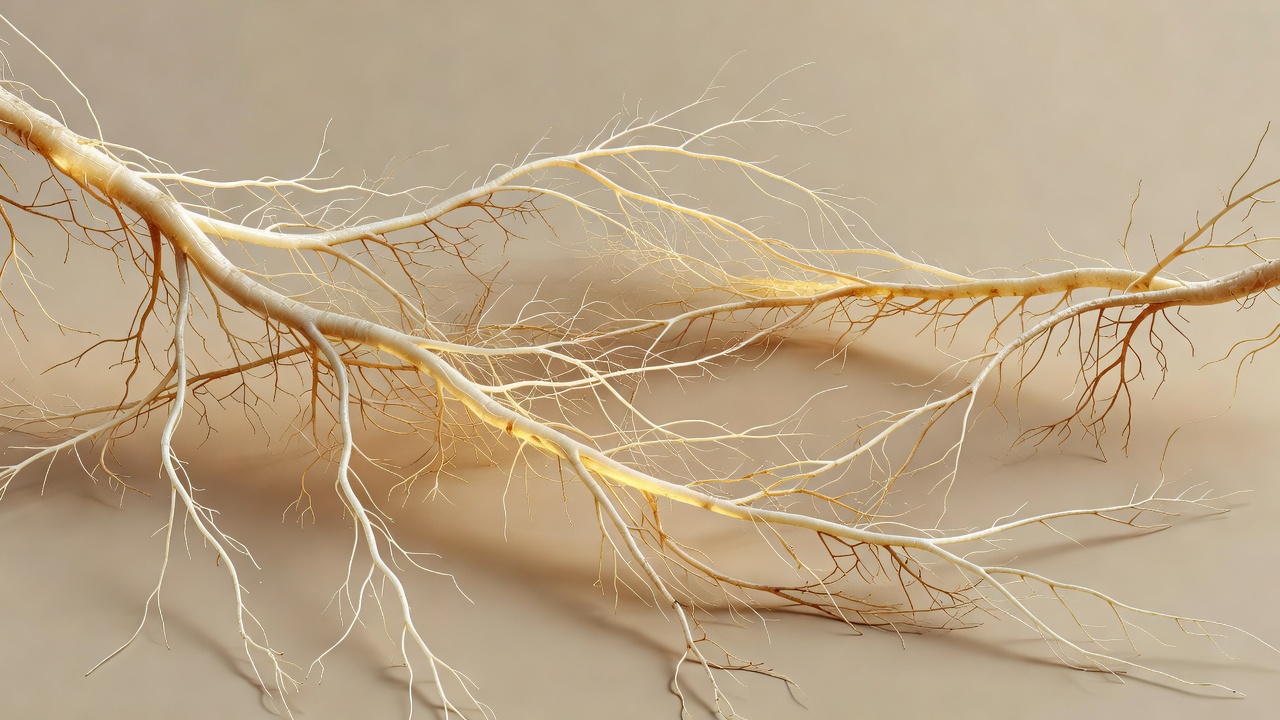
A common mycorrhizal network can occur when fungal mycelium connects roots of more than one plant. A fungus may associate with multiple individuals, sometimes of different plant species. However, finding the same fungal species on two roots does not establish that a continuous living connection exists between them. Researchers may need genetic identification, spatial sampling and experimental barriers to narrow down the possibilities.
Even a confirmed connection does not establish its ecological importance. A useful next question is whether material moves through it, followed by how much moves and what happens afterward. Carbon detected in a recipient’s tissues may represent a small flux rather than a substantial subsidy. The destination also matters: carbon in associated fungi is not equivalent to carbon incorporated into a neighboring tree’s own tissue.
CLAIM / FINDING / LIMIT
“Trees feed one another through the fungal internet.”
Experiments have traced carbon movement between plants in some mycorrhizal systems.
The route, magnitude and consequences require separate tests. Movement alone does not demonstrate intentional sharing.
Following carbon without skipping steps
Isotope tracers allow scientists to distinguish newly labeled carbon from background carbon. In a widely discussed 1997 Nature study, Suzanne Simard and colleagues investigated carbon transfer involving paper birch and Douglas-fir. That research helped draw attention to belowground connections. It did not settle every question about resource transfer across forests, nor did it establish that all mature trees support nearby seedlings.
Alternative routes are a persistent challenge. Roots can release compounds into soil; microbes can transform them; dissolved substances can move with water. Root grafts may connect some trees directly. Mesh barriers can help separate roots from hyphae, but barriers also alter the experimental environment. Strong interpretation therefore depends on controls that match the specific mechanism being claimed.
What the disagreements add
A 2023 review by Justine Karst, Melanie Jones and Jason Hoeksema examined claims about common mycorrhizal networks in forests and warned about overinterpretation and positive citation bias. A critical review does not erase evidence for mycorrhizal associations. It asks whether the evidence supports particular claims about widespread networks, seedling benefits or preferential transfer to relatives.
Researchers continue to investigate these questions using different species, settings and methods. The productive position is neither “the network explains everything” nor “nothing happens underground.” It is to specify the organism, pathway, measurement and outcome. A convincing result in a pot, plantation or temperate woodland may suggest a hypothesis elsewhere, but it is not a universal forest rule.
Read the relationship, not the personality
Fungi are organisms with their own evolutionary interests. They are not passive cables installed for trees. Competition, selective exchange and changing resource availability can shape their behavior. On a woodland walk, the visible mushroom is only a reproductive structure, not a map of the whole mycelium. Leave roots and soil undisturbed, and treat the hidden network as a research question rather than a story that observation alone can confirm.