Counting tree species is a useful beginning, but it misses much of a forest. Fungi digest wood. Beetles occupy the tunnels they create. Birds forage in bark crevices. Seedlings establish where light and moisture allow. Bacteria and other microorganisms participate in nutrient transformations. These organisms encounter one another in habitats whose size, age and physical conditions vary across short distances.
Structure creates opportunities
A forest with trees of different sizes, scattered gaps, standing dead trunks and fallen wood provides a range of conditions. A shaded log may remain moist while exposed litter dries. A canopy opening can favor light-demanding plants while nearby shade-tolerant species persist beneath intact crowns. Structural variety can therefore support organisms with different needs, although the response depends on the forest and its history.
Tree cavities illustrate why time matters. They may form through injury, decay or excavation, and become nesting or shelter sites for birds, bats and invertebrates. Replacing an old tree with a sapling does not immediately replace those features. Conservation often requires continuity of habitat, not merely an equivalent number of living stems.
Decomposition is a community process
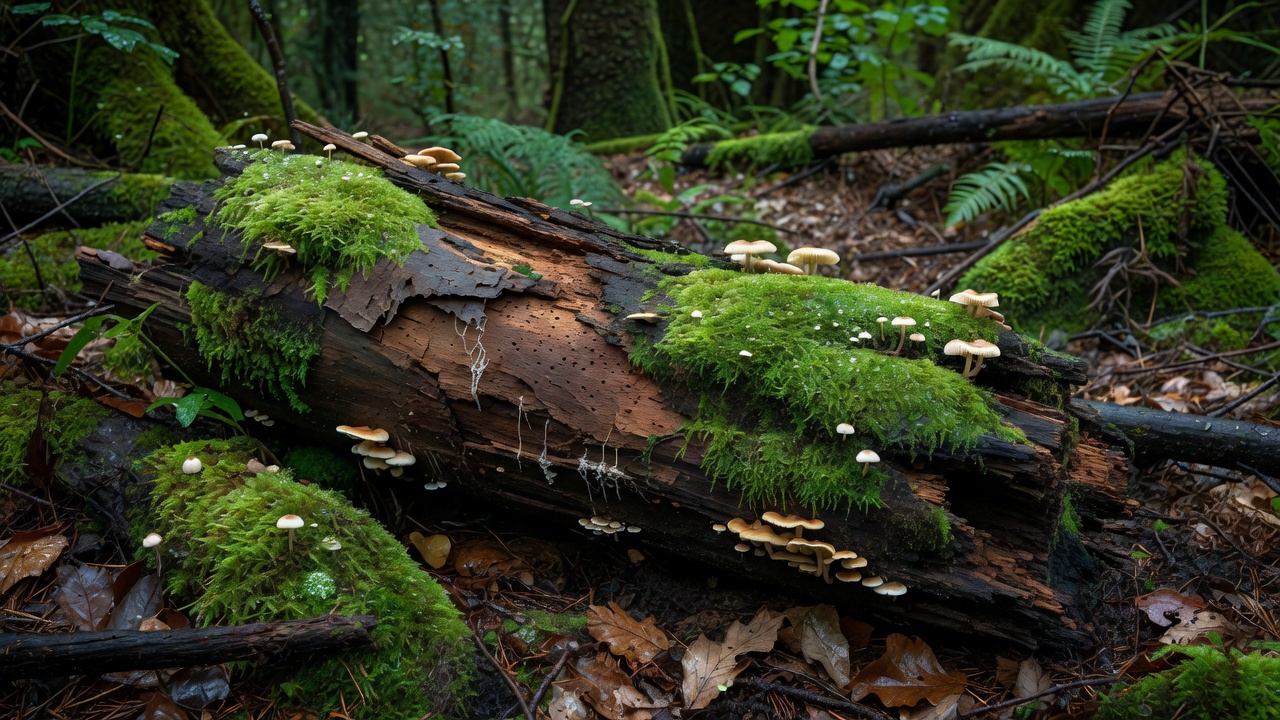
Fallen wood passes through stages of decay. Fungi differ in the components they can break down and in the conditions under which they grow. Invertebrates fragment material and create passages. Microbes transform compounds and immobilize or release nutrients. Temperature, oxygen and moisture influence the pace. The resulting process is not a simple conveyor belt returning every nutrient immediately to nearby trees.
Some nutrients can remain tied up in organisms or organic matter for long periods. Others move beyond a local patch. Carbon may remain stored in wood or soil, or return to the atmosphere through respiration. Understanding this balance requires measurements over time. A visually untidy forest can be ecologically rich, but appearance alone does not quantify its carbon balance.
Food webs are not chains with one direction
A seed can become a seedling, food for a rodent or a cached resource that is never recovered. A bird can eat fruit and disperse seeds away from the parent plant. Herbivores affect plants, predators affect herbivores, and pathogens influence survival at several levels. The outcome changes with abundance, season and location.
Mutualisms and antagonisms can also overlap. An animal that disperses some seeds may destroy others. A fungus beneficial under one set of conditions may impose costs under another. Describing the relationship precisely is more useful than assigning every species a permanent role as a helper or enemy.
FIELD COMPARISON
Species richness records how many species are detected.
Community composition records which species occur and how their abundances differ.
Functional and genetic diversity reveal differences a species count may miss.
Place changes the relationship
Research at Barro Colorado Island in Panama has helped ecologists study tropical tree communities over time. Work at Hubbard Brook Experimental Forest in New Hampshire has examined ecosystem processes, including water and nutrient movement. Long-term observations at Harvard Forest in Massachusetts connect changing climate, land-use history and forest dynamics. These sites ask overlapping questions in different ecological settings.
Białowieża Forest in Europe is often discussed in relation to old forest structure and deadwood. Amazonian forests demonstrate enormous biological and environmental variation across a large region. Neither is a template for every woodland. A species-rich tropical plot, a boreal stand and an urban wood can require different baselines and management goals.
Disturbance is not a single category
Windthrow, fire, drought, disease and harvesting differ in timing, extent and severity. Some organisms depend on conditions produced by disturbance. Others require long continuity. Climate change can alter the frequency or intensity of events, and fragmentation can restrict movement between suitable habitats. “Natural disturbance” is therefore not a blanket explanation for any loss of forest cover.
For a reader or visitor, a useful practice is to notice habitat features without disturbing them. Look for canopy layers, fallen branches, wet hollows and regeneration. Record observations from paths, follow local access rules and avoid moving deadwood or peeling bark. Forest biodiversity is a living set of relationships, and observation is most informative when it does not dismantle the habitat being observed.